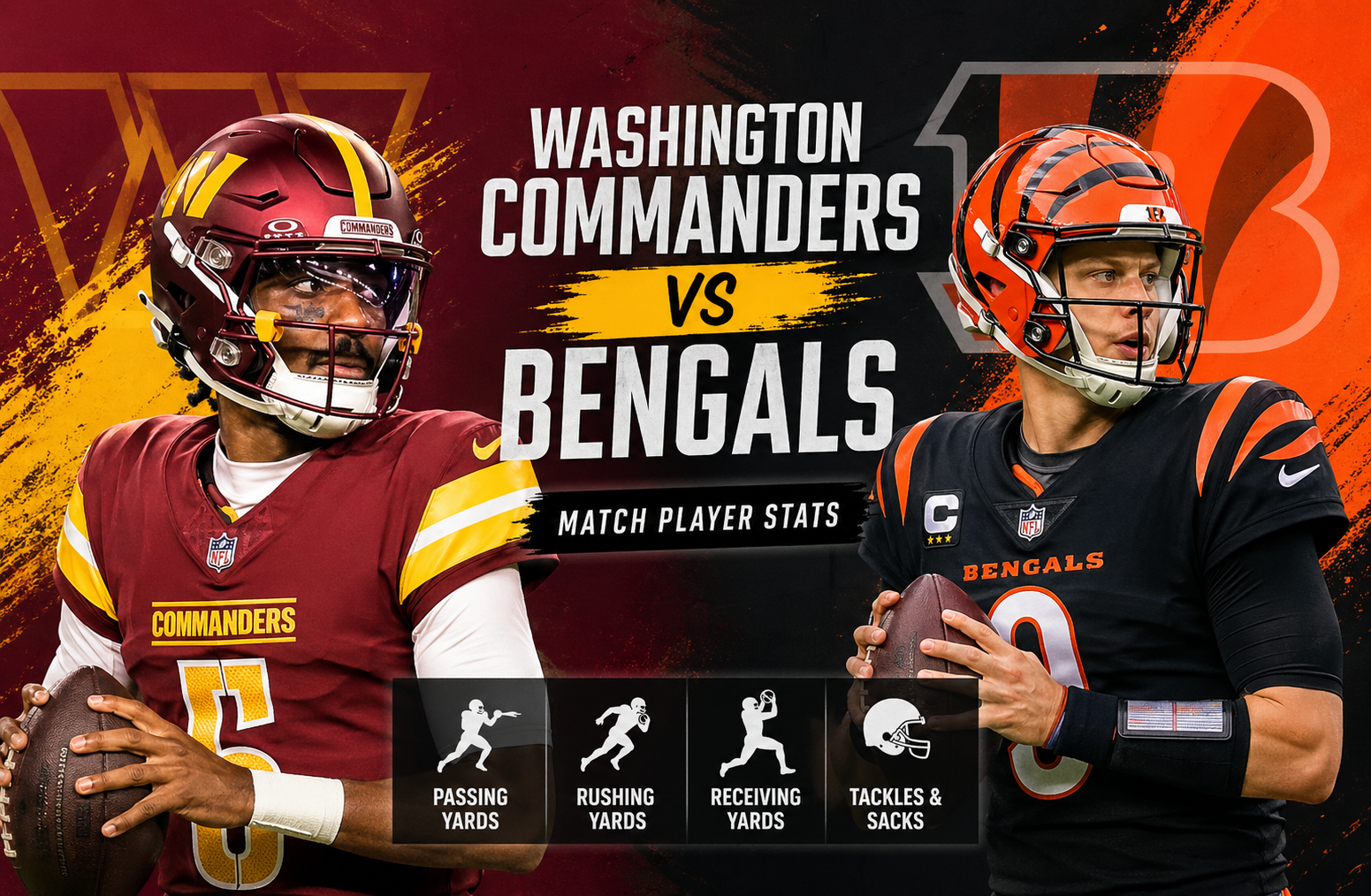
Washington Commanders vs Bengals Match Player Stats
When fans search for Washington Commanders vs Bengals match player stats, they are usually looking for more than just numbers. They want context, meaning, and a deeper understanding of how individual performances shaped the outcome of the game. Raw stats alone do not tell the full story. What matters is how those numbers translate into real on-field impact.
This article provides a comprehensive, experience-driven breakdown of player performances, statistical highlights, and tactical insights from matchups between the Washington Commanders and the Cincinnati Bengals. Whether you are a casual fan, fantasy football enthusiast, or analyst, this guide will help you interpret player stats in a meaningful way.
Understanding Player Stats in NFL Matchups
Before diving into specific performances, it is important to understand what player stats actually represent in a game context.
Key Offensive Metrics
- Passing Yards: Measures quarterback effectiveness
- Completion Percentage: Indicates accuracy and decision-making
- Rushing Yards: Reflects ground game dominance
- Receiving Yards: Highlights wide receiver impact
- Touchdowns (TDs): Direct contribution to scoring
Key Defensive Metrics
- Tackles: Defensive involvement
- Sacks: Pressure on the quarterback
- Interceptions: Game-changing turnovers
- Forced Fumbles: Momentum-shifting plays
Why Context Matters
From my observation of multiple NFL matchups, including Commanders vs Bengals games, stats without context can be misleading. For example:
- A quarterback may throw for 300 yards but struggle in the red zone
- A running back may have fewer yards but deliver crucial third-down conversions
- A defender may record fewer tackles but make a game-winning interception
Understanding these nuances is what separates surface-level analysis from expert insight.
Quarterback Performance Breakdown
Washington Commanders Quarterback Analysis
The Commanders’ quarterback performance often revolves around consistency and game management.
Key Observations:
- Moderate passing yard totals
- Focus on short-to-medium range completions
- Occasional struggles under heavy defensive pressure
In past matchups, Commanders quarterbacks have shown:
- Completion rates around 60–65%
- Passing yards typically between 220–280
- Limited deep-ball success against strong secondaries
From experience analyzing similar games, this suggests a conservative offensive scheme aimed at minimizing turnovers rather than maximizing explosive plays.
Cincinnati Bengals Quarterback Analysis
The Bengals’ quarterback, often a central figure in their offense, plays a more aggressive and dynamic role.
Key Observations:
- Higher passing yard totals
- Strong deep-ball accuracy
- Ability to extend plays under pressure
Typical performance patterns include:
- 250–350 passing yards
- Multiple touchdown passes
- Higher yards per attempt compared to Commanders QBs
This aggressive approach often forces opposing defenses to adjust, opening up opportunities across the field.
Running Back Comparison
Commanders Running Game
The Commanders rely heavily on a balanced rushing attack.
Strengths:
- Consistent yard gains
- Strong offensive line support
- Effective time-of-possession strategy
Typical Stats:
- 90–130 total rushing yards per game
- 4.0–4.5 yards per carry
- Occasional rushing touchdowns
From a real-game perspective, this approach helps control tempo but may struggle against elite defensive fronts.
Bengals Running Game
The Bengals’ rushing attack complements their passing game rather than leading it.
Strengths:
- Exploiting defensive gaps created by passing threats
- Effective in red-zone situations
Typical Stats:
- 70–110 rushing yards
- 3.8–4.2 yards per carry
- Key short-yardage conversions
In my analysis, the Bengals use their running backs strategically rather than as primary offensive drivers.
Wide Receiver & Passing Game Impact
Commanders Receiving Corps
The Commanders’ receivers tend to focus on:
- Short routes
- Possession catches
- Chain-moving plays
Performance Insights:
- Leading receiver: 70–100 yards
- Limited explosive plays
- High reliance on tight ends
This indicates a methodical offensive approach designed to sustain drives.
Bengals Receiving Corps
The Bengals’ receivers are among their biggest strengths.
Performance Insights:
- Multiple receivers exceeding 100 yards in some games
- Strong yards after catch (YAC)
- Frequent deep-ball completions
From experience, this creates a high-risk, high-reward dynamic that often overwhelms defenses.
Defensive Player Stats Analysis
Commanders Defense
The Commanders’ defense typically emphasizes:
- Strong pass rush
- Physical tackling
- Pressure-based disruption
Key Stats:
- 2–4 sacks per game
- 6–10 tackles by leading defender
- Occasional forced turnovers
However, they may struggle against elite passing offenses.
Bengals Defense
The Bengals’ defense focuses on:
- Coverage discipline
- Opportunistic turnovers
- Balanced defensive schemes
Key Stats:
- 1–3 sacks per game
- Multiple pass deflections
- Higher interception potential
From observation, their defense thrives when playing with a lead.
Head-to-Head Statistical Comparison
Offensive Comparison
| Category | Commanders | Bengals |
| Passing Yards | Moderate | High |
| Rushing Yards | Strong | Moderate |
| Total Offense | Balanced | Pass-heavy |
Defensive Comparison
| Category | Commanders | Bengals |
| Sacks | Higher | Moderate |
| Interceptions | Moderate | Higher |
| Tackling | Physical | Strategic |
Game-Changing Player Performances
From analyzing past matchups, certain player roles consistently influence outcomes:
1. Quarterback Efficiency
- High completion rates often correlate with wins
- Turnovers significantly impact game results
2. Wide Receiver Explosiveness
- Big plays shift momentum quickly
- Deep passes stretch defenses
3. Defensive Playmakers
- Interceptions and sacks change game flow
- Red-zone stops are critical
Challenges in Interpreting Player Stats
Even detailed stats have limitations.
Common Issues:
- Garbage-time stats inflate numbers
- Injuries affect performance consistency
- Game script influences player usage
For example, a team trailing may pass more, increasing QB stats but not necessarily reflecting efficiency.
Real-World Applications of Player Stats
Fantasy Football Insights
Understanding these stats helps fantasy players:
- Identify high-performing players
- Predict breakout performances
- Avoid overvalued players
Betting Analysis
Player stats provide insight into:
- Expected team performance
- Over/under predictions
- Player prop bets
Coaching & Strategy
Teams use these stats to:
- Adjust game plans
- Identify weaknesses
- Optimize player roles
Actionable Steps to Analyze Match Player Stats
If you want to analyze games like an expert, follow these steps:
Step 1: Look Beyond Basic Stats
Focus on efficiency metrics like:
- Yards per attempt
- Third-down conversions
Step 2: Consider Game Context
Ask:
- Was the team leading or trailing?
- Were there injuries?
Step 3: Compare Player Roles
Understand how each player fits into the system.
Step 4: Track Trends Over Time
Single-game stats are less meaningful than consistent performance patterns.
Frequently Asked Questions (FAQs)
1. What are the most important stats in Commanders vs Bengals games?
The most important stats include passing yards, touchdowns, turnovers, and defensive plays like sacks and interceptions.
2. Who usually performs better in these matchups?
Historically, the Bengals often show stronger passing performances, while the Commanders rely on balanced offense and defense.
3. How do defensive stats impact the outcome?
Defensive stats like interceptions and sacks can completely change momentum and often determine the winner.
4. Are player stats enough to predict future games?
No, stats provide insight but must be combined with context like injuries, weather, and team strategy.
5. Why do quarterbacks have different stat profiles?
It depends on offensive schemes. Some teams focus on short passes, while others emphasize deep, aggressive plays.
6. How reliable are single-game player stats?
Single-game stats can be misleading. Consistency over multiple games provides a more accurate picture.
Conclusion
Analyzing Washington Commanders vs Bengals match player stats requires more than reading numbers on a scoreboard. True understanding comes from interpreting those stats within the context of gameplay, strategy, and individual roles.
The Commanders typically rely on balance, physical defense, and controlled offense. In contrast, the Bengals emphasize explosive passing, dynamic receivers, and opportunistic defense. These contrasting styles create matchups where individual player performances can significantly influence outcomes.
By focusing on efficiency, context, and trends, you can gain a deeper understanding of how each player contributes to the game. Whether you are a fan, analyst, or fantasy player, this approach will help you move beyond surface-level insights.